- June 26, 2026
- PCB Blog, PCB Manufacturing
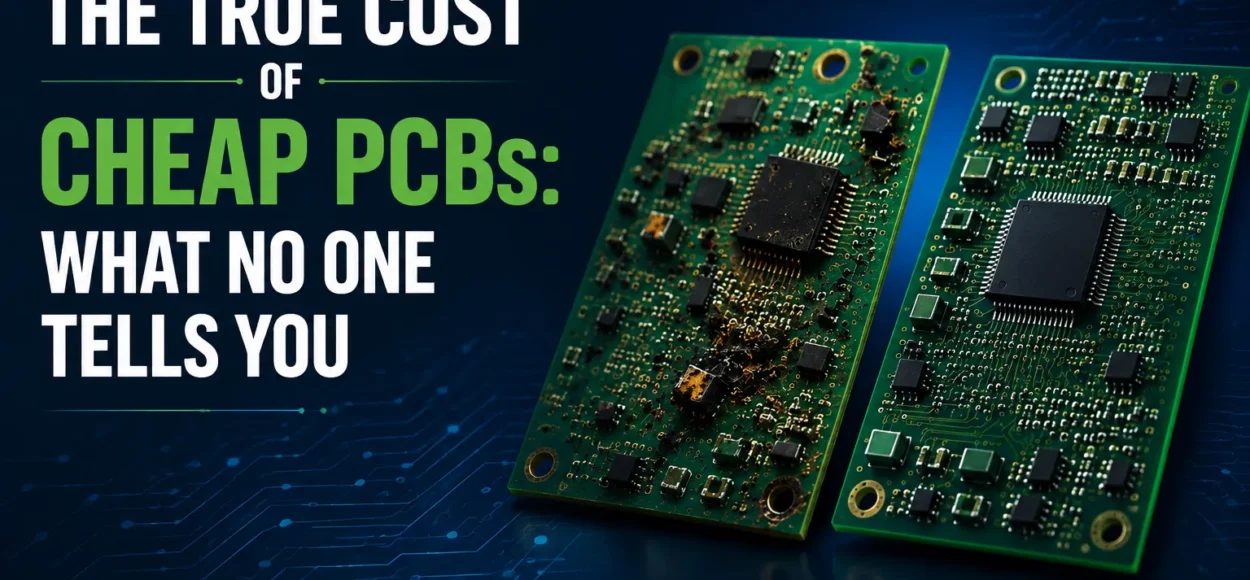
The True Cost of Cheap PCBs: What No One Tells You
Core Question: Why are low-cost PCB quotes often misleading?
Let’s start with a hard truth.
If you’re choosing a PCB supplier based on price alone, you’re not saving money. You’re placing a bet. And more often than not, it’s a bad one.
Because the cheapest quote on the table is rarely the lowest cost in the end.
Engineers know this—at least intellectually. Program managers feel it in their schedules. Procurement often learns it the hard way. Yet the cycle repeats itself every day: a low quote comes in, it looks good on paper, it checks the boxes, and someone says, “Let’s go with them.”
And that’s where the trouble begins.
This isn’t about bashing low-cost suppliers. There are good ones out there.This is about understanding the difference between price and cost—and why confusing the two can derail your product, your timeline, and your reputation.
Let’s break it down.
The Illusion of Low Upfront Pricing
A low PCB quote is seductive. It gives you the feeling of winning before the work even begins.
You look at the number and think:
“We just saved 20%.”
“We’re under budget.”
“We made a smart decision.”
But here’s the problem—what you’re seeing is only one piece of the equation.
A PCB quote typically reflects:
- Bare board fabrication cost
- Basic material assumptions
- Standard tolerances
- Ideal production conditions
What it doesn’t reflect:
- Real-world manufacturability challenges
- Engineering back-and-forth
- Yield issues
- Communication delays
- Rework cycles
- Logistics complications
In other words, the quote assumes everything will go perfectly.
And in electronics manufacturing, that assumption is almost always wrong.
The illusion isn’t the number itself—it’s the belief that the number tells the whole story.
It doesn’t.
Quality Issues That Show Up Later
Cheap PCBs rarely fail immediately. That’s what makes them dangerous.
They pass initial inspection. They might even pass functional testing. But over time, under stress, under heat, under real-world conditions—that’s when the cracks start to show.
Common issues include:
- Inconsistent impedance control
- Poor plating thickness
- Delamination under thermal cycling
- Microvia reliability failures
- Solder mask misregistration
- Material substitutions that weren’t clearly communicated
These are not theoretical problems. They’re the kind of issues that show up:
- During system integration
- During environmental testing
- During field deployment
And when they do, they don’t just cost money—they cost time, credibility, and sometimes customers.
An engineer once said it best:
“The board didn’t fail in the lab. It failed in the customer’s hands.”
That’s the worst place for failure.
Because now you’re not just fixing a board—you’re repairing trust.
Delays That Cost More Than the Board
Here’s where the math really starts to break down.
Let’s say you saved $500 on a PCB order by choosing a lower-cost supplier.
Sounds good—until:
- The boards arrive late
- There’s a fabrication issue
- You need a revision
- Communication takes 48 hours per cycle
Suddenly, your timeline slips by a week. Then two. Then three.
Now ask yourself:
What is a week of delay worth?
For a product launch, it could mean:
- Missed market windows
- Lost revenue opportunities
- Delayed customer commitments
For a development program, it could mean:
- Idle engineering resources
- Rescheduled testing
- Increased program costs
That $500 savings? It disappears instantly.
In fact, it often turns into thousands—sometimes tens of thousands—in downstream impact.
Speed isn’t just a convenience. It’s a competitive advantage.
And cheap suppliers rarely prioritize it the way you need them to.
Hidden Costs in Logistics and Communication
This is where things get even more subtle—and more expensive.
When you work with a low-cost supplier, especially offshore, you’re not just buying boards. You’re buying a communication model.
And that model often includes:
- Time zone delays
- Language barriers
- Limited real-time support
- Email-only problem solving
- Lack of proactive communication
Every question takes longer to answer. Every issue takes longer to resolve.
And every delay compounds.
Then there’s logistics:
- Shipping delays
- Customs complications
- Unexpected tariffs or fees
- Limited flexibility for expedited orders
These aren’t line items on a quote. But they are very real costs.
Program managers feel this pain acutely. Because they’re the ones trying to keep everything on track while the clock keeps ticking.
And the more complex the project, the more these hidden costs matter.
Risk vs Reward in Offshore Sourcing
Let’s be clear—offshore sourcing isn’t inherently bad. Many excellent PCB manufacturers operate globally.
But the decision to go offshore purely for cost introduces a different risk profile.
You’re trading:
- Lower unit cost
for - Increased uncertainty
And that uncertainty shows up in:
- Quality consistency
- Lead time reliability
- Engineering collaboration
- Responsiveness
The real question isn’t “Is offshore cheaper?”
It’s:
“Is the risk worth the savings?”
In high-volume, stable designs with minimal complexity, the answer might be yes.
But in:
- Prototyping
- High-reliability applications
- Complex HDI designs
- Tight timelines
The margin for error is smaller.
And the cost of getting it wrong is much higher.
Why Reliability Matters More Than Price
Engineers don’t just design circuits. They design outcomes.
And those outcomes depend on reliability.
A reliable PCB:
- Performs consistently
- Meets specifications
- Survives real-world conditions
- Integrates smoothly into the system
An unreliable PCB does the opposite.
And here’s the key point:
Reliability is not a feature you can add later. It’s built into the process from the beginning.
It comes from:
- Material selection
- Process control
- Engineering expertise
- Quality systems that actually work
These things cost money. There’s no way around it.
So when a quote is significantly lower than others, you have to ask:
“What’s being compromised?”
Because something always is.
Case Study: Cheap vs Right Decision
Let’s walk through a real-world scenario.
A mid-sized electronics company was developing a new RF product. Tight timeline. Competitive market. Pressure to reduce costs.
They received two PCB quotes:
- Supplier A: 20% lower cost
- Supplier B: Higher cost, strong reputation
Procurement pushed for Supplier A. The numbers made sense—on paper.
First run:
- Boards arrived late
- Minor quality issues
- Some rework required
Second run:
- More significant issues
- Yield dropped
- Engineering had to step in
Third run:
- Major reliability concerns
- Project delayed by six weeks
At that point, they switched to Supplier B.
Result:
- Higher upfront cost
- Smooth production
- On-time delivery
- No major issues
Final analysis:
The “cheap” option ended up costing:
- Additional engineering hours
- Rework expenses
- Delayed market entry
- Lost revenue
Total cost? More than double what they would have spent by choosing the right supplier from the start.
This is not an isolated story. It happens every day.
Total Cost vs Unit Cost Thinking
This is where the mindset has to change.
Most organizations still evaluate PCBs based on unit cost.
But smart organizations focus on total cost.
Total cost includes:
- Fabrication
- Assembly impact
- Yield rates
- Engineering time
- Communication overhead
- Logistics
- Risk
- Time-to-market
When you look at the full picture, the cheapest option rarely wins.
Because total cost is about outcomes, not just inputs.
It’s about:
- Getting it right the first time
- Moving fast without breaking things
- Delivering reliable products to customers
And that requires a different way of thinking.
What Engineers Should Really Look For
If price isn’t the primary driver, what should be?
Engineers and program managers should evaluate PCB suppliers based on:
- Responsiveness: How quickly do they answer questions? Solve problems? Provide updates?
- Engineering Support: Do they help you optimize your design? Or just build what you send?
- Process Control: Do they have systems in place to ensure consistency and reliability?
- Transparency: Do they communicate issues early? Or hide them until it’s too late?
- Track Record: Have they successfully delivered similar projects?
- Speed: Can they meet your timeline without compromising quality?
These factors don’t always show up in a quote. But they determine the outcome.
The Real Question You Should Be Asking
Instead of asking:
“Who has the lowest price?”
Start asking:
“Who will get this right the first time?”
Because that’s the question that actually matters.
And the answer isn’t always obvious.
It requires:
- Due diligence
- Technical evaluation
- Honest conversations
But it’s worth it.
Because the cost of getting it wrong is always higher than the cost of getting it right.
Final Thought: Cheap Is Expensive
Let’s make this simple.
Cheap PCBs aren’t cheap.
They’re expensive in ways that don’t show up on a quote:
- In delays
- In rework
- In stress
- In lost opportunities
The companies that win in today’s market understand this.
They don’t chase the lowest price.
They invest in the right partners.
They think in terms of total cost, not unit cost.
And they make decisions based on outcomes, not assumptions.
Because in the end, it’s not about how much you paid for the board.
It’s about what it cost you to use it.
And that’s a number you can’t afford to ignore.
Don't Let Cheap PCBs Cost You More
From prototype to production, Precision PCB delivers dependable manufacturing solutions that minimize rework, improve product reliability, and keep your projects on schedule.
Quality Manufacturing. Predictable Results.