- June 10, 2026
- PCB Assembly, PCB Blog, PCB Design, PCB Manufacturing
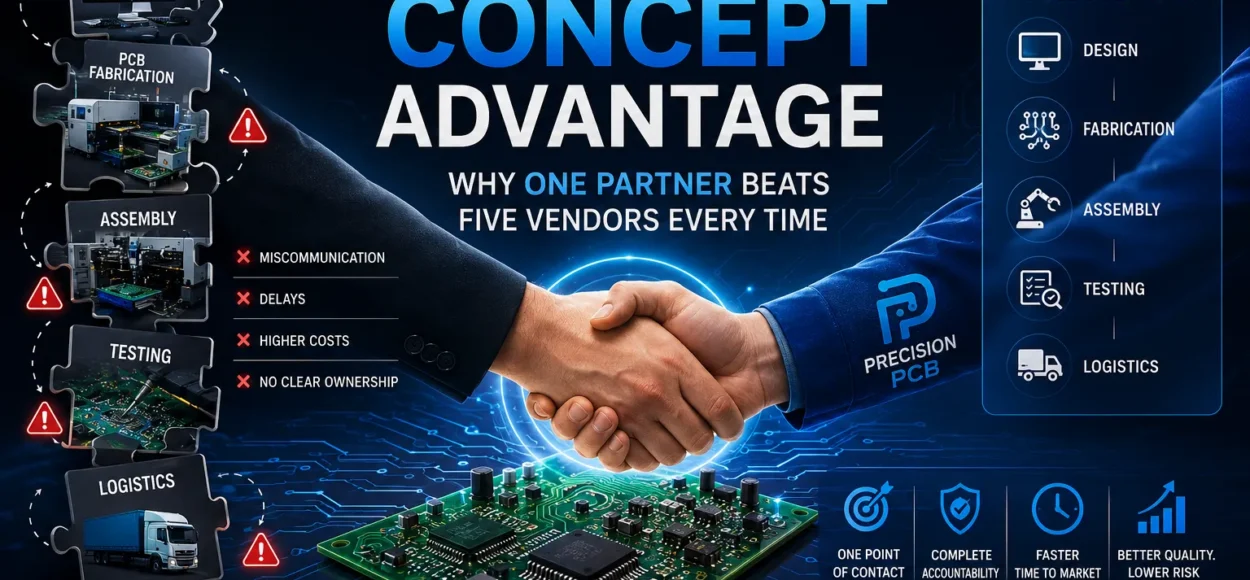
The Total Concept Advantage: Why One Partner Beats Five Vendors Every Time
There’s a moment in almost every electronics project when things start to feel… harder than they should be.
The design is solid. The idea is right. The market is ready.
And yet, progress slows.
Emails multiply. Questions go unanswered. Timelines stretch. Small issues turn into big ones. And suddenly, instead of building a product, you’re managing a process.
If that sounds familiar, you’re not alone.
It happens every day in companies that rely on multiple vendors to get a single product to market. Design in one place. Fabrication in another. Assembly somewhere else. Testing, logistics, revisions—each handled by a different group, each with its own priorities, its own systems, and its own interpretation of what needs to happen next.
On paper, it looks efficient.
In reality, it’s where good projects go to slow down.
And that’s exactly why more companies are moving toward something smarter, faster, and far more reliable: the Total Concept approach—one partner, one process, complete accountability from design through delivery.
The Day the Project Slipped
Let’s start with a story.
A mid-sized electronics company—smart team, strong product concept—was racing to launch a new device into a competitive market. They had done everything right, or so they thought. The design was outsourced to a respected firm. Fabrication was assigned to a trusted PCB shop. Assembly was handled by a separate EMS provider.
Each vendor was good at what they did.
Individually, they were excellent.
Collectively, they were a problem.
The first signs showed up quietly. A question from the fabricator about trace widths that didn’t quite align with manufacturing capabilities. A delay while the design team reviewed it. Then another question from assembly about component placement that hadn’t been optimized for pick-and-place efficiency.
Each issue was small.
But each one required coordination.
And coordination required time.
Emails went back and forth. Clarifications were made. Assumptions were corrected. And with every step, the timeline stretched.
Weeks turned into months.
And by the time the product was finally ready, the market had already moved.
That’s the cost no one calculates.
Not just dollars.
But opportunity.
The Hidden Cost No Spreadsheet Shows
When companies talk about cost, they usually focus on unit price.
What does fabrication cost? What does assembly cost? Can we shave a few dollars here or there?
But the real cost of a fragmented process isn’t on an invoice.
It’s in the friction.
It’s in the hours spent chasing updates.
It’s in the delays caused by misalignment.
It’s in the rework that comes from misinterpretation.
And most of all, it’s in the mental load placed on your team.
Because when you work with multiple vendors, someone has to connect the dots.
Someone has to translate between design intent and manufacturing reality.
Someone has to make sure that what one vendor assumes is actually what another vendor can deliver.
More often than not, that someone is you.
Or your engineers.
Or your operations team.
Highly skilled people, spending their time managing complexity instead of creating value.
That’s the hidden cost.
And it adds up faster than anything on a purchase order.
Where Communication Breaks—and Why It Matters
If you trace most project delays back to their source, you’ll find a common thread: communication breakdown.
Not because people aren’t trying.
But because the system isn’t built for alignment.
When design, fabrication, and assembly are separated, communication becomes fragmented. Each vendor sees only their piece of the puzzle. Each one makes decisions based on partial information.
And partial information leads to imperfect outcomes.
A design that looks great on a screen may not translate cleanly into fabrication. A board that meets fabrication specs may introduce challenges during assembly. Testing requirements may be interpreted differently depending on who’s handling them.
None of these issues are catastrophic on their own.
But together?
They create drag.
And in a market where speed matters, drag is dangerous.
Because every delay is a chance for a competitor to move ahead.
The Power of Continuity
Now imagine a different scenario.
Instead of separate vendors, you have one integrated team.
Design engineers sit alongside manufacturing experts. Fabrication specialists understand the assembly requirements from the start. Everyone is working from the same data, the same goals, the same timeline.
That’s continuity.
And continuity changes everything.
Instead of discovering problems late, you prevent them early. Instead of reacting to issues, you anticipate them. Instead of working in sequence, you work in parallel.
The result is a process that feels… smoother.
Faster.
More predictable.
And predictability, in this industry, is everything.
Because when you can trust the process, you can move with confidence.
One Purchase Order, Total Control
There’s also something refreshingly simple about working with a single partner.
One purchase order.
That’s it.
No juggling contracts. No coordinating terms across multiple vendors. No tracking separate timelines and deliverables.
Just one agreement, covering everything from design optimization to final assembly.
It might sound like a small detail.
It’s not.
It’s a shift in how work gets done.
Because when you reduce administrative complexity, you free up time and attention. You remove friction from the system. You create space for focus.
And focus is what drives execution.
When Problems Happen—and They Will
Let’s be realistic.
No project is perfect.
Problems happen.
Components go out of stock. Designs need adjustment. Unexpected challenges arise during fabrication or assembly.
The difference isn’t whether problems occur.
It’s how they’re handled.
In a multi-vendor environment, problems trigger a chain reaction. Each vendor analyzes the issue independently. Responsibility becomes a conversation. Solutions take time to coordinate.
And while everyone is talking, the clock keeps ticking.
In an integrated environment, the response is different.
The team already understands the full context. They have access to the same information. They’re aligned around the same outcome.
So instead of asking, “Whose problem is this?”
They ask, “How do we fix it?”
And then they do.
Quickly.
That speed of resolution is one of the most underrated advantages of the Total Concept approach.
Because in a fast-moving market, the ability to solve problems quickly is often the difference between success and delay.
Accountability Changes Everything
There’s another shift that happens when you move to a single partner model.
Accountability becomes clear.
There’s no ambiguity about who owns the outcome.
No finger-pointing.
No passing the issue from one vendor to another.
Just one team, responsible for delivering results.
That clarity has a powerful effect.
It changes behavior.
Because when a partner knows they are accountable for the entire process, they approach every decision differently. They think beyond their specific role. They consider the downstream impact. They act with a broader perspective.
And that leads to better outcomes.
Not because the individuals are different.
But because the system is.
A Better Way Forward: A Real Example
Let’s go back to our earlier story.
After months of delays and frustration, that same electronics company made a decision. They shifted to a full-service partner—one team handling design refinement, fabrication, and assembly.
The transition wasn’t dramatic.
But the results were.
Suddenly, communication improved. Questions were answered in real time. Design adjustments were made with manufacturing input. Fabrication and assembly were aligned from the beginning.
The next prototype came together faster.
The one after that was even smoother.
And when it came time to move into production, there were no surprises.
The product launched.
On time.
With confidence.
Same company.
Same product.
Different approach.
Why Engineers Lean Toward Integration
Ask engineers what they value most, and you’ll hear a consistent answer: clarity.
They want to know that what they design can be built. That what gets built will perform. That the process won’t introduce unnecessary variables.
Integrated solutions deliver that clarity.
They provide direct access to manufacturing expertise during the design phase. They reduce the guesswork. They create a feedback loop that improves decisions in real time.
And perhaps most importantly, they reduce surprises.
Because in engineering, surprises are rarely a good thing.
Beyond Efficiency: A Competitive Edge
It’s easy to think of the Total Concept approach as a way to improve efficiency.
And it does.
But that’s only part of the story.
The real value is strategic.
Companies that operate with integrated partners move faster. They adapt more quickly. They bring products to market with fewer delays and higher confidence.
Over time, that advantage compounds.
They’re not just completing projects.
They’re building momentum.
While others are managing complexity, they’re focusing on growth.
While others are solving preventable problems, they’re creating new opportunities.
And in a competitive market, that difference becomes hard to ignore.
Why This Matters More Than Ever
The electronics industry isn’t slowing down.
Products are becoming more complex. Timelines are getting tighter. Customer expectations are rising.
There’s less room for error.
Less tolerance for delay.
And far less patience for inefficiency.
In that environment, the way you manage your process becomes a competitive decision.
Do you accept the friction of a fragmented system?
Or do you choose a model built for alignment, speed, and accountability?
That’s the real question.
The Total Concept Advantage, Defined
At its core, the Total Concept Advantage is about alignment.
One partner.
One team.
One process.
From design through fabrication, assembly, and delivery.
It’s about removing the gaps where problems hide.
It’s about creating continuity where performance improves.
And it’s about taking something complex—and making it work the way it should.
Smoothly.
Reliably.
Predictably.
Closing Thought
There’s a reason more companies are rethinking how they build.
They’ve experienced the friction of managing multiple vendors. They’ve felt the delays, the miscommunication, the missed opportunities.
And they’ve realized something simple.
It doesn’t have to be that hard.
Because when everything is aligned—when design, fabrication, and assembly work as one—the process changes.
It becomes faster.
Cleaner.
More controlled.
And ultimately, more successful.
So the choice isn’t just about vendors.
It’s about how you want to work.
You can keep managing the complexity.
Or you can eliminate it.
And move forward with a partner who’s built to deliver—not just pieces of the process, but the entire result.
Because in the end, that’s what matters.
Not how many vendors you use.
But how well everything comes together.
And when it does?
That’s when real progress begins.
Move Faster with One Trusted PCB Manufacturing Partner
From design support and PCB fabrication to assembly, testing, and logistics, Precision PCB provides complete manufacturing solutions under one roof. Eliminate communication gaps, reduce production delays, and launch your products with confidence—all through a single experienced partner.
One partner. One process. Faster results.